3Blue1Brown videos and learning guides
Choose a path through 43 3Blue1Brown videos in the Talkshelf catalog. Start with the mathematical idea you need, then connect the visual explanation to a small calculation, drawing or experiment of your own. The collection includes selected videos discussed on Hacker News; it covers several subjects rather than every chapter of each original series.
Build intuition for vectors and linear algebra
Begin with Vectors: chapter 1 of Essence of Linear Algebra. Familiarity with coordinates is enough to start. Draw a vector as an arrow, write its components, then add and scale it both ways. Explain what changes when you move an arrow without changing its direction or length.
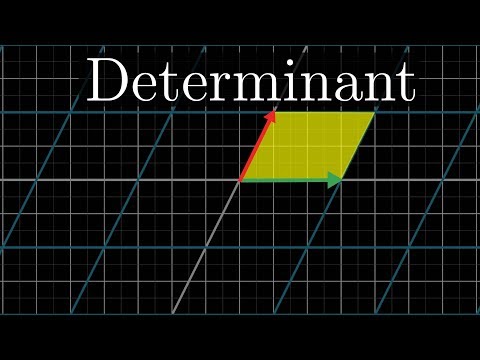
The catalog also includes the series preview, The determinant and Eigenvectors and eigenvalues. Before the later chapters, become comfortable with matrices and linear transformations. Try predicting how a transformation changes area or a particular direction before watching the animation. These four selections are starting points within Essence of Linear Algebra, not a complete chapter sequence. Follow the original series between these selected chapters.
Understand neural networks before coding
Start with But what is a neural network?, then continue to Gradient descent and Backpropagation, intuitively. Basic functions and derivatives help with the training explanations. After each video, sketch the network and describe the role of a weight, an activation and a loss without looking at your notes.
For language models, continue with Transformers, the tech behind LLMs and Attention in transformers, step-by-step. Keep track of what each vector represents and how information moves between tokens. When you want to implement the ideas, follow the Andrej Karpathy learning guide for Python-based coding sessions and their prerequisites.
Connect calculus with Fourier transforms
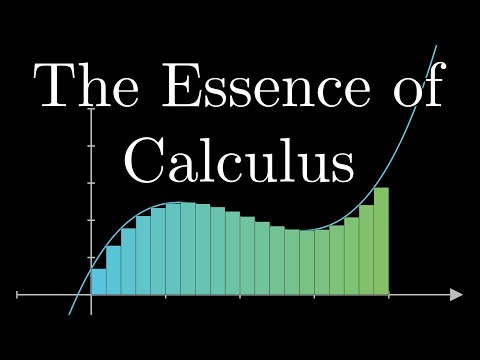
The essence of calculus is an entry point for thinking about change and accumulation. Use a familiar graph to connect a slope with a rate of change, then ask what information its accumulated area represents.
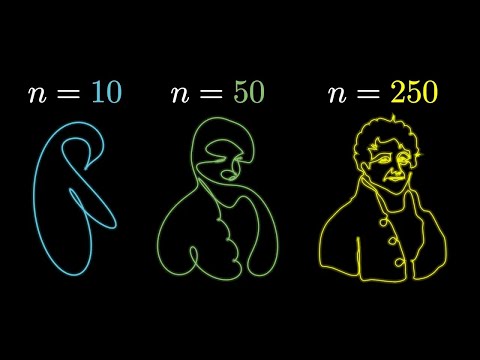
Continue with the visual introduction to the Fourier transform when you are comfortable reading functions and graphs. Follow it with Fourier series: from heat flow to drawing with circles. Sketch a simple repeating signal and explain how changing a frequency changes the picture. Revisit a short segment whenever the animation makes sense but the explanation in your own words does not.
Try visual probability and information theory
For a focused problem, choose Bayes theorem: the geometry of changing beliefs or Solving Wordle using information theory. Basic probability is useful. Write down your initial guess, calculate one small example, and compare your reasoning with the video's explanation. This makes a good single-session path when you do not want to begin a longer series.
Study materials and discussion
The Vectors guide currently includes English notes, a quiz, editable flashcards and a PPT outline. Other videos in this channel collection remain available to watch with catalog overviews and collected HN discussion; their material labels show whether study resources are available.
Read the discussion for questions about prerequisites, applications and places where an explanation needs another pass. Return to the video to test the idea, then keep a short record of what you can now draw, calculate or explain.
All 43 videos in this channel
 9:51
Vectors | Chapter 1, Essence of linear algebra
 19:42
But what is the Fourier Transform? A visual introduction.
 18:40
But what is a neural network? | Deep learning chapter 1
 25:16
But how does bitcoin actually work?
 27:14
Transformers, the tech behind LLMs | Deep Learning Chapter 5
 17:05
The essence of calculus
 5:09
Essence of linear algebra preview
 11:15
The hardest problem on the hardest test
 10:03
The determinant | Chapter 6, Essence of linear algebra
 21:36
Fractals are typically not self-similar
 25:13
Thinking outside the 10-dimensional box
 17:16
Eigenvectors and eigenvalues | Chapter 14, Essence of linear algebra
 18:07
The more general uncertainty principle, regarding Fourier transforms
 31:51
Visualizing the 4d numbers Quaternions
 15:08
What does it feel like to invent math?
 23:12
Simulating an epidemic
 22:11
But what is the Riemann zeta function? Visualizing analytic continuation
 16:30
Who cares about topology? (Old version)
 22:21
Why do prime numbers make these spirals? | Dirichlet’s theorem and pi approximations
 28:34
But why would light "slow down"? | Visualizing Feynman's lecture on the refractive index
 26:10
Attention in transformers, step-by-step | Deep Learning Chapter 6
 24:47
But what is a Fourier series? From heat flow to drawing with circles | DE4
 7:42
Triangle of Power
 18:18
Hilbert's Curve: Is infinite math useful?
 20:05
But what are Hamming codes? The origin of error correction
 21:14
The medical test paradox, and redesigning Bayes' rule
 4:08
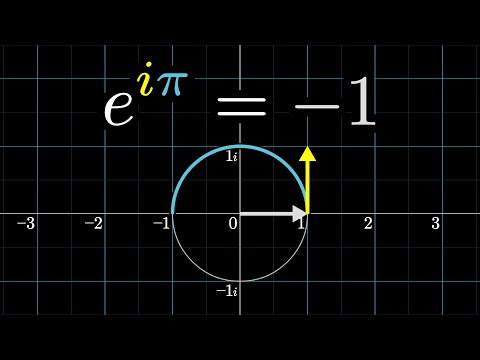
e^(iπ) in 3.14 minutes, using dynamics | DE5
 12:47
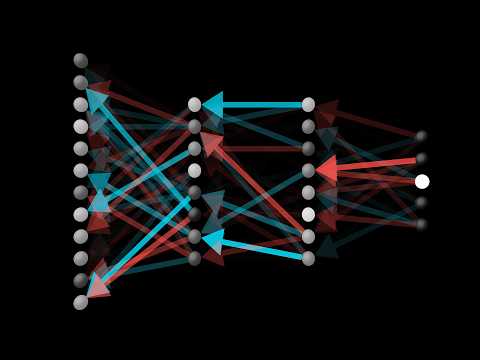
Backpropagation, intuitively | Deep Learning Chapter 3
 29:43
Pi hiding in prime regularities
 46:24
How are holograms possible?
 20:33
Gradient descent, how neural networks learn | Deep Learning Chapter 2
 5:06
How secure is 256 bit security?
 24:28
Euler's formula with introductory group theory
 53:41
How I animate 3Blue1Brown | A Manim demo with Ben Sparks
 28:33
Terence Tao on the cosmic distance ladder
 15:11
Bayes theorem, the geometry of changing beliefs
 10:18
Backpropagation calculus | Deep Learning Chapter 4
 30:38
Solving Wordle using information theory
 8:57
Exponential growth and epidemics
 22:22
Some light quantum mechanics (with minutephysics)
 51:16
What is Euler's formula actually saying? | Ep. 4 Lockdown live math
 21:58
Group theory, abstraction, and the 196,883-dimensional monster
 37:20